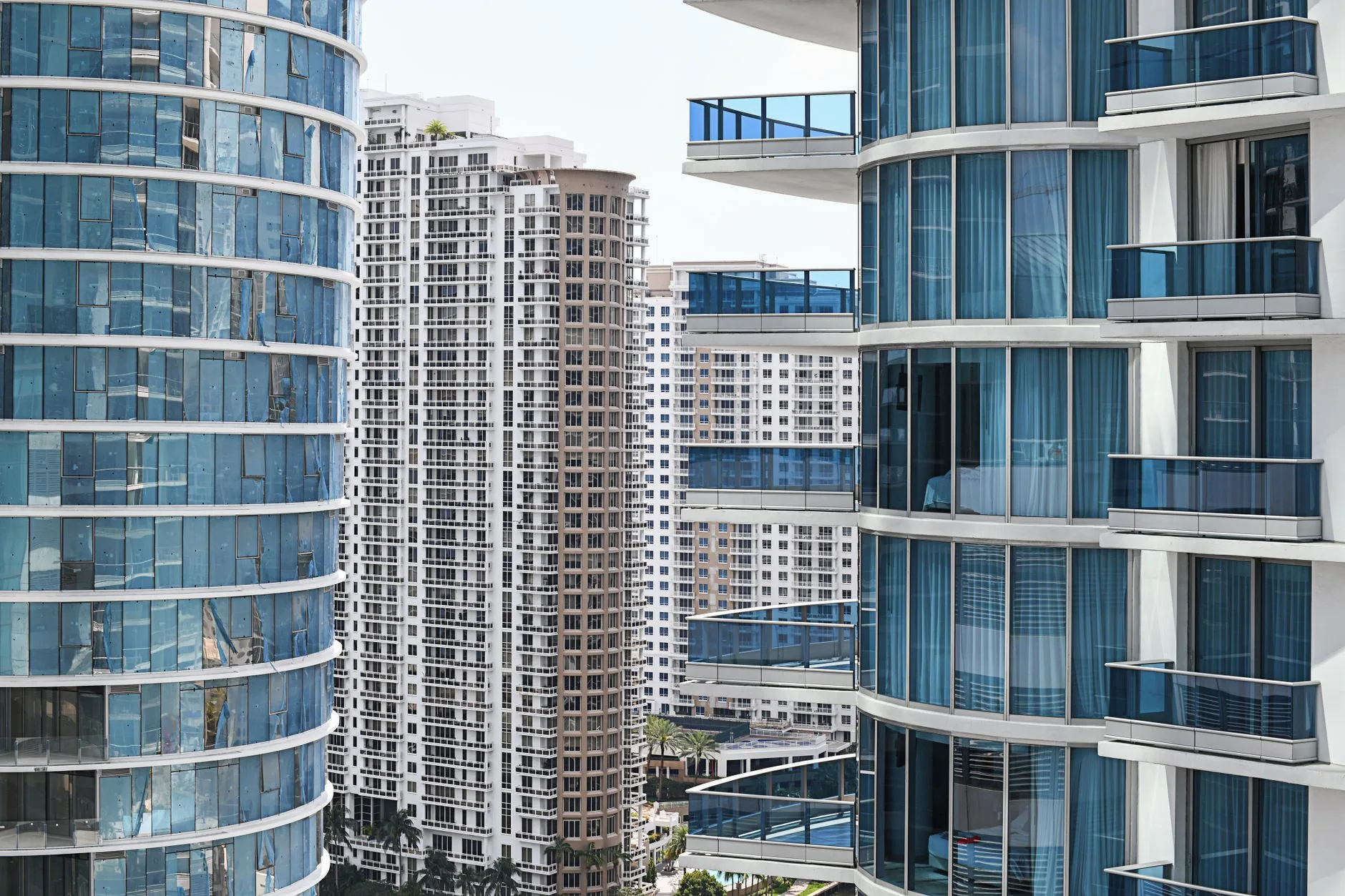
The Residences at 1428 Brickell puts photovoltaic glazing on a 70-story residential tower on Brickell Avenue. Ytech, the developer, describes the building as the world's first high-rise partially powered by solar energy. The qualifier carries the claim.
Photovoltaic glazing in plain terms
Photovoltaic glazing is window glass with a solar cell layer built into the assembly. Sunlight strikes the layer. The layer produces direct-current electricity. An inverter converts that current to the alternating current a building distributes.
The array occupies facade area the building already buys, so it needs no separate roof or canopy footprint.
The Solar Backbone by the numbers
The system runs along the west-facing elevation. It uses approximately 500 solar-integrated windows across nearly 20,000 square feet of energy-producing glass. Ytech calls the assembly a Solar Backbone.
Published output reaches up to 175,000 kilowatt-hours a year. The release pairs that figure with an estimated reduction of 4,700 tons of CO2 and savings of about 3,000 barrels of oil annually. Every figure is the developer's. No utility filing, metering report or independent verification accompanies them.
What 175,000 kilowatt-hours buys
Divide the output by the glass area and the array yields roughly 8.75 kilowatt-hours per square foot a year. That ratio ties the energy claim to the glass the building buys.
Divide the same output by 195 residences and the annual figure falls to about 897 kilowatt-hours per home, or roughly 75 kilowatt-hours a month. The release publishes no figure for what a residence consumes, so the comparison stops there.
Where the electricity goes
Florida YIMBY's report of 3 September 2026 scopes the output to the building's common areas. That is the operative sentence for anyone reading the claim. The array offsets shared load.
The release names three pools, a 10,000-square-foot gym, a two-story wine and art lounge, a spa, office suites and furnished guest suites. Those are the shared systems the array would serve. The record breaks the 175,000 kilowatt-hours down across none of them.
The west elevation carries the array
The west face takes Miami's afternoon sun, which is the hottest band of the day. A west-facing array collects at the hours when a building's cooling load peaks. The release publishes no cooling-load figure, no shading coefficient, no solar heat gain value and no measured interior temperature comparison.
The release states that the system sits in the windows themselves and extends the panels' lifespan to match the glass. It attaches no number to that glass life. The line stands as a maintenance claim.
The panel lifetime claim
A rack-mounted panel can be pulled and replaced on its own. A cell laminated into a window unit is replaced with the window unit.
Ytech's answer is the matched lifespan line. The record carries no degradation curve, no warranty term and no replacement protocol. A buyer or a lender asking about year 20 has nothing in the file to read.
What a second developer would have to file
A repeat of this specification on another Brickell tower requires the glazing decision at the curtain-wall shop drawing stage. It also requires a metering plan that separates array output from house load and a commissioning protocol that proves the inverter is working after handover.
The record carries none of those three documents for 1428 Brickell. It carries the windows, the square footage and the annual figure. The next Brickell filing that wants the same claim has three documents to produce.
What the record does not publish
No cost premium for the glazing. No efficiency rating for the cells. No inverter model or count. No storage. No utility interconnection agreement. No measured output against the 175,000 kilowatt-hour projection. No share of the building's total consumption.
Ytech's claim stands on the design and on the projection. A meter reading would settle it.